guide
Airport Help for Elderly Travellers Flying Alone
A practical look at what elderly parents and grandparents need for a Vietnamese airport arrival, and how airline help compares with private assistance.
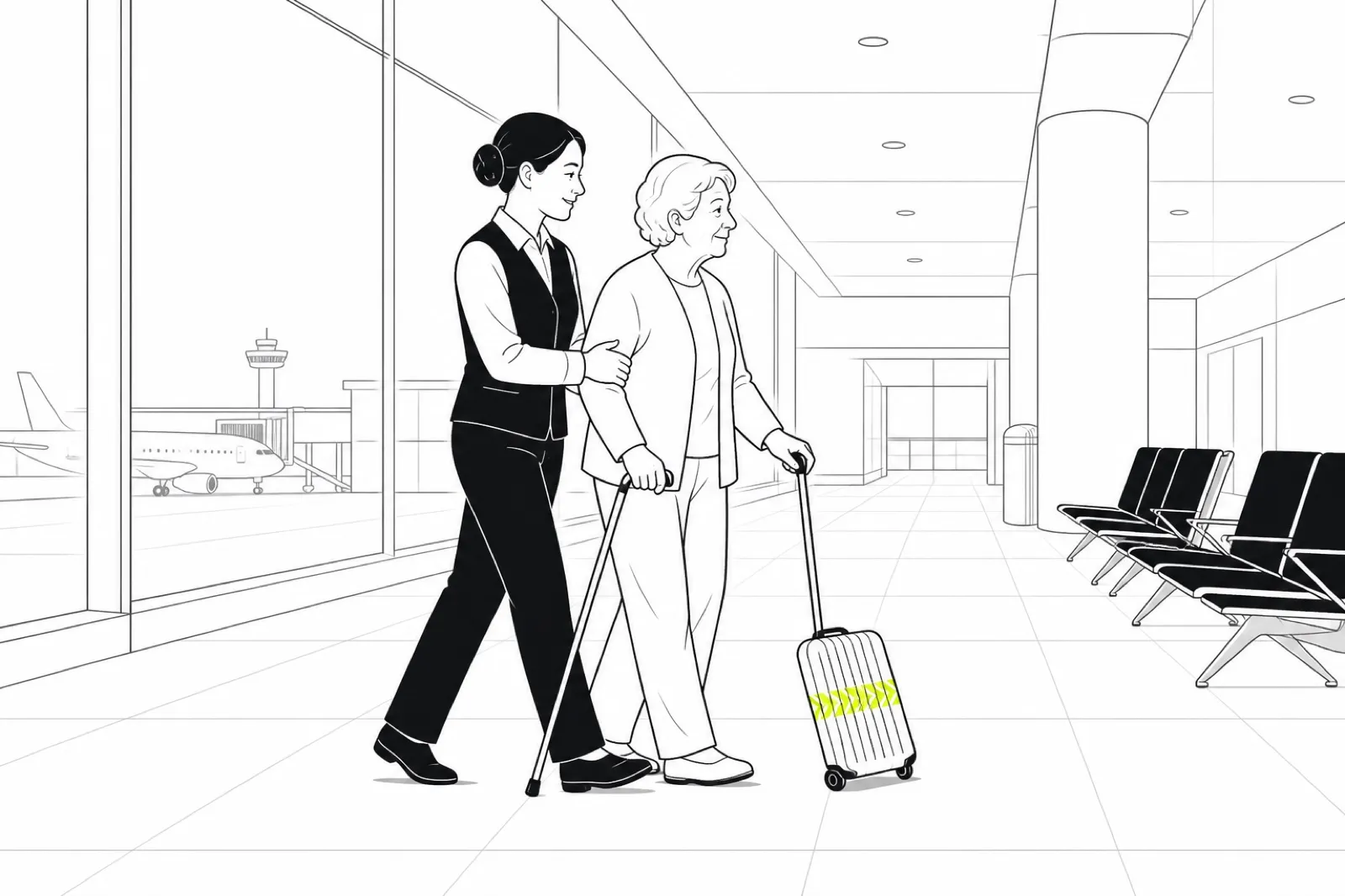
Flying alone gets harder with age, not the destination
An older parent or grandparent who has flown internationally for decades can still find a long-haul trip to Vietnam different from what they remember. It is rarely the flight itself that wears people down — it is the walk after it: long piers, a hall full of strangers, forms to find, a bag that has to be located and carried. None of that is about capability. It is about stamina, unfamiliar signage, and not knowing who to ask.
Families weighing whether to arrange help are usually not worried about a single hard step. They are worried about the accumulation of small ones, one after another, with no one nearby who knows the building.
What the airline already provides
Most airlines carry some form of assistance for older passengers, usually booked as a mobility or special-assistance request at ticketing. It typically covers movement between the gate and immigration, sometimes a buggy or wheelchair for longer distances, and priority boarding. It is airport staff doing airport-scale work — efficient, but shared across many passengers on the same bank of flights, and not built around one traveller’s whole journey. For the mechanics of that airline-run service specifically, wheelchair and mobility assistance in Vietnam covers what is and isn’t included.
Where private assistance picks up
A private assistant — sometimes called a meet-and-greet service — waits for one traveller, not a rotation of them. The difference shows up in the parts airline staff cannot cover: staying with the same person the entire way rather than handing them off between zones, carrying or arranging a porter for bags at reclaim, and walking them out to whoever is collecting them at the kerb rather than leaving them at a door. Porter help with bags and a pre-booked transfer usually get arranged in the same booking.
A realistic list: what to arrange before the trip
- Confirm the airline’s own assistance request early — it is often free to book but needs advance notice, not a same-day add-on.
- Decide whether the traveller needs a wheelchair for distance, or simply a companion and a slower pace; the two are arranged differently.
- Write down who is meeting them at the destination, including a phone number, in case a connection is missed.
- Pack essential medication and documents in a bag that stays with the traveller, not checked luggage.
- If any entry paperwork is required, handle it through the proper government channels ahead of the trip — nobody at the airport can arrange or speed that up on the day.
The honest limits — what no one can promise
An assistant can shorten the confusing parts of a journey and be a steady, familiar face in an unfamiliar building. What no service can do is skip a queue that exists for everyone, or promise a fixed time from aircraft door to kerb — arrival volumes and staffing on any given day sit outside anyone’s control. Every traveller, however frail or however assisted, goes through the same official steps, and the officer at the counter makes the same decision for each of them.
Making the decision together
The right amount of help is a family conversation, not a default. Some elderly travellers want a companion for the whole route; others only need someone waiting at the door with a name sign and a plan for the car. Naming the actual worry — a long walk, a connection, a language gap — makes it far easier to book the right level of support instead of over- or under-arranging it.