guide
What a Meet-and-Greet Service Covers
What "meet-and-greet" actually includes at a Vietnamese airport, how the arrival and departure versions differ, and who tends to book each.
The basic idea
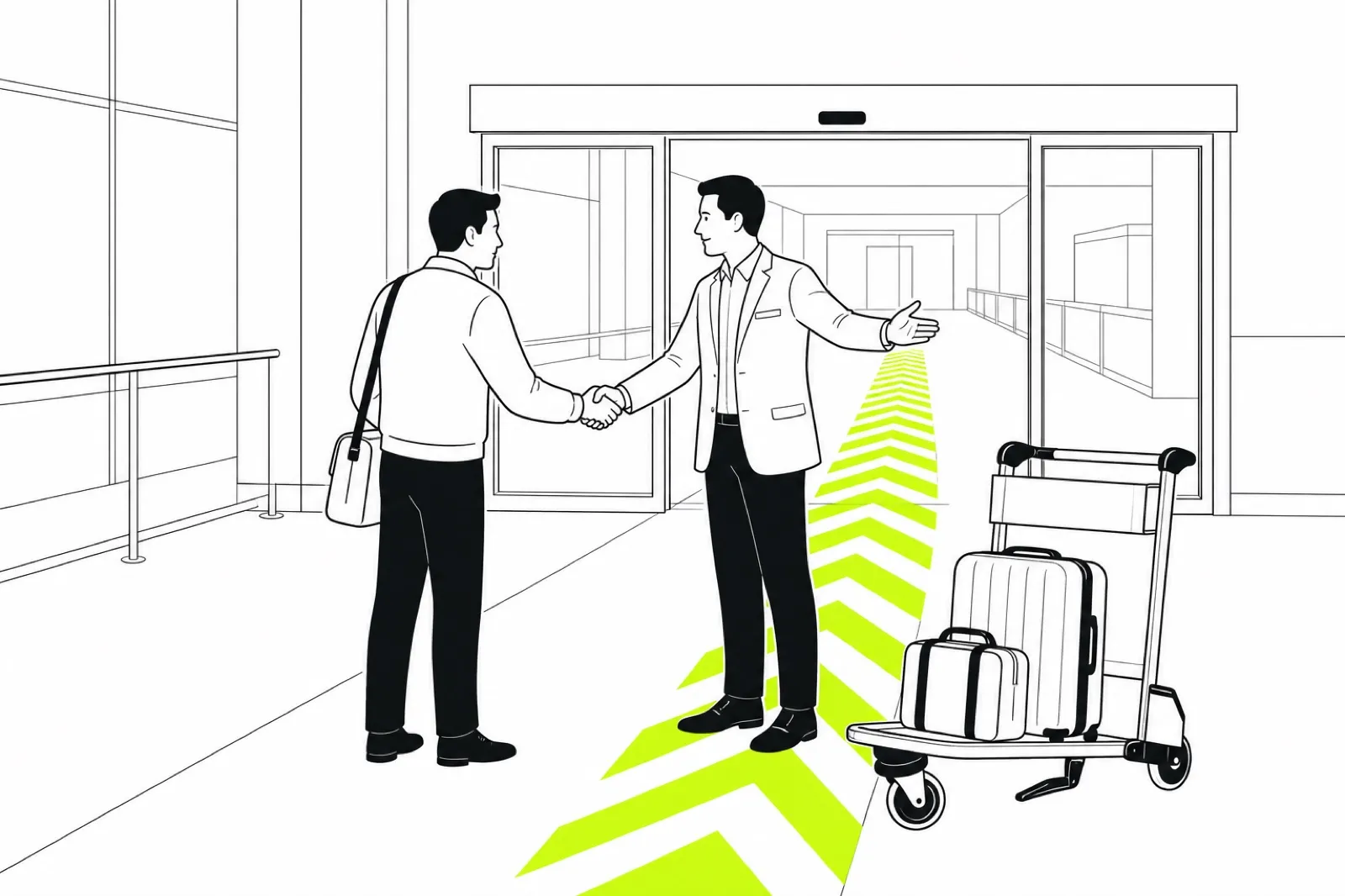
The phrase gets used loosely, so it helps to define it once. A meet-and-greet is a named person who waits for a specific traveller at a specific point in the terminal — usually as close to the gate as the airport allows, sometimes further back if arrival access is restricted — and stays with them through the rest of the journey through the building. It is not a group tour and not a generic information desk; it is one escort assigned to one traveller or one travelling party.
The arrival version, step by step
On landing, the escort waits at the agreed point holding a name sign, then walks with the traveller through the terminal at whatever pace suits them. Through the immigration hall this usually means pointing to the correct queue and making sure entry documentation is ready to present — the escort cannot speak to an officer on a traveller’s behalf, and every decision at that counter is the officer’s alone. At baggage reclaim the escort helps locate the right belt and, if a porter service is included, moves the bags to a trolley. Through customs the standard green or red channel choice applies to everyone equally. The last stretch is the arrivals hall itself, where the escort walks the traveller to a waiting driver or a taxi rank rather than leaving them to find it in a crowd of strangers holding signs.
The departure version
Going the other direction, the escort typically meets the traveller at the kerb or the terminal entrance, helps with check-in if it is not already done online, confirms document checks before the entry to the departure hall, and walks with them as far as security allows before handing off to airport staff for the screening process itself. For anyone flying alone who finds a big departure hall stressful, this is often the more valuable half of the two — it is covered in more depth on the departure assistance page.
What it does not include
It is worth being precise about the boundary. A meet-and-greet escort does not sit inside immigration, customs or security processes — those remain between the traveller and the officer at every step, with no shortcut a private service can create. It does not obtain or expedite entry paperwork; that is arranged through official government channels before the trip, and the escort’s role is limited to making sure it is in hand and organised, not to influencing the outcome. And it is not a substitute for airline-arranged wheelchair or unaccompanied minor programs, both of which are booked directly with the airline and covered on their own pages.
Who benefits most
A traveller flying into Vietnam for the first time, with no local language and a long-haul flight behind them, gets the most obvious lift from having someone waiting rather than orienting themselves cold — see the first-trip tips page for what tends to surprise people. Parents or grandparents travelling solo, families landing with young children in tow, and wheelchair users who want an escort beyond the standard airline service are the other groups who book this most often; each has a dedicated page working through the specifics, including wheelchair and mobility assistance.
Booking one for someone else
A large share of meet-and-greet bookings are made by a person who is not travelling — an adult child arranging help for a parent, a host arranging help for a visiting relative. That works fine in practice: the booking just needs the traveller’s name, flight details, and a meeting point spelled out precisely rather than left as “outside arrivals,” which in a large modern terminal can describe several hundred metres of kerb. The person arranging it from afar can also confirm afterward, by phone or message, that the handoff happened — useful reassurance when you cannot be there yourself.