guide
Arrival Help for Families with Young Children
Landing in Vietnam with a stroller, a toddler and too many bags - what actually slows families down, and where an extra pair of hands helps most.
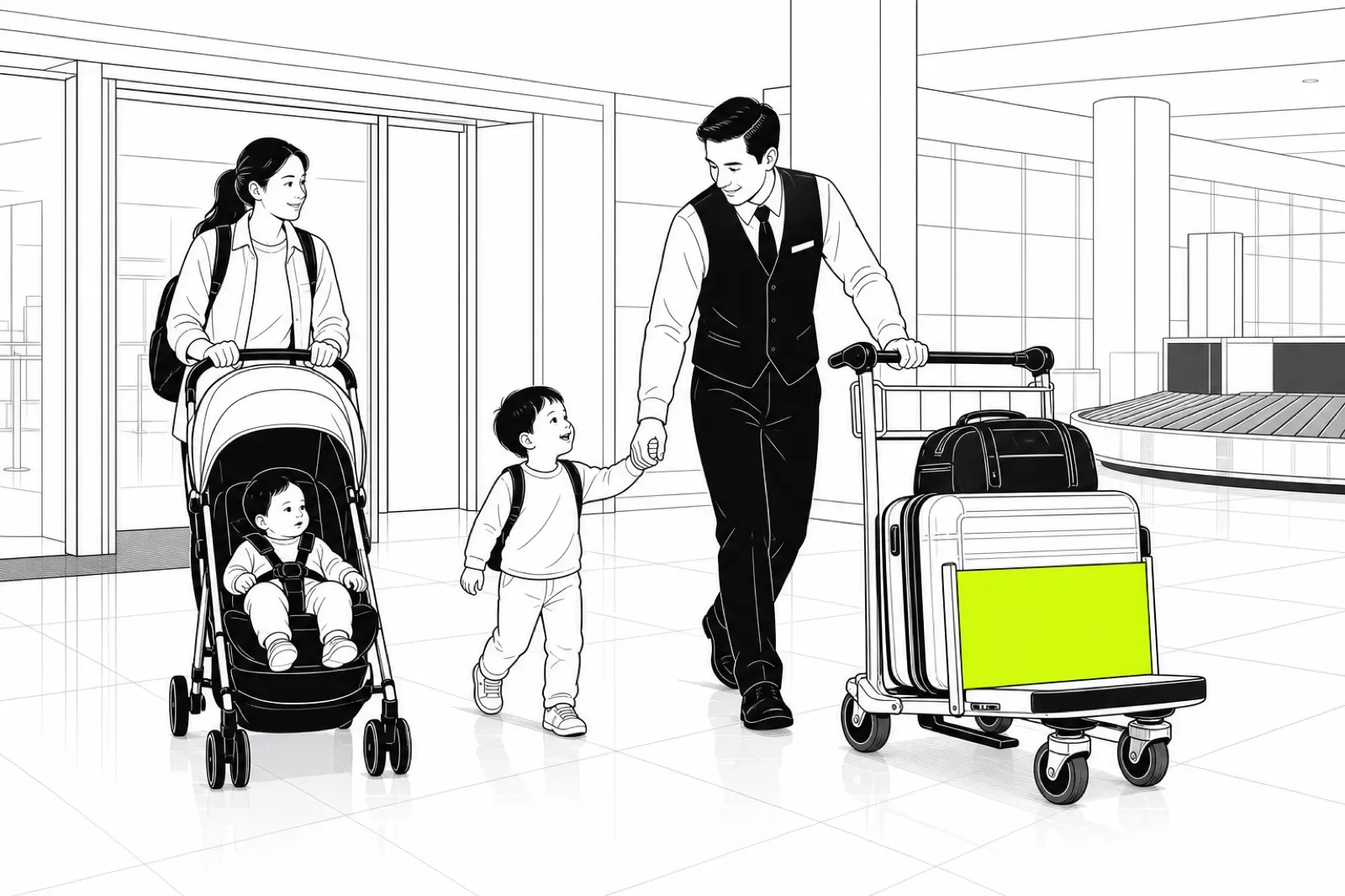
The moment the doors open
The jet bridge door opens and a family with small children steps into a terminal that assumes everyone else is moving at business pace. A toddler wants to be carried. An infant needs a fresh bottle. There is one stroller, three bags, and two adults who now have to fold the stroller, hold a passport, and keep a wandering child within reach, usually all at once.
Strollers and car seats: what changes at the gate
Most airlines gate-check strollers, which means the stroller reappears at the door of the aircraft or, more often, gets delivered to a designated point after immigration rather than at baggage reclaim — worth confirming with cabin crew before landing so no one goes looking for it in the wrong hall. Car seats generally travel as checked baggage unless pre-arranged otherwise. Either way, a parent lands holding a child who has nowhere to sit until the stroller turns up, which is exactly the gap an assistant meeting the family at the gate is built to close.
Immigration with kids in tow
Queues move at the pace of the slowest document in the line, and a tired toddler does not make anyone move faster. Families are usually better off joining the general line with paperwork already organised — passports out, anything required for entry sorted in advance through official channels — than hunting for a shortcut that does not exist. What genuinely helps is a second adult, or an assistant, holding the child and the bags while the other parent handles documents at the counter. The officer at the desk still makes every decision, for every family in that line, exactly as they would for a traveller without children; nothing about having a child changes that step.
A double stroller, a car seat, and a diaper bag all take up counter space at exactly the moment a family needs both hands free for passports. Standing slightly to the side while documents are checked, rather than crowding the desk with gear, tends to keep the line moving for everyone behind.
Baggage, bags, and one more human
Baggage reclaim with children is a logistics problem: someone has to watch the belt, someone has to watch the kids, and someone has to lift a case that outweighs the toddler on your hip. This is the point in the journey where a spare pair of hands changes the whole feel of arrival — not by speeding anything up, but by turning a three-person job back into a one-person job for each adult. Porter help for bags is worth arranging in advance for a family carrying a full set of luggage plus travel gear.
The last stretch: kerb, taxi, transfer
By the time a family clears customs, patience is usually running low on both sides. Arriving to a named driver holding a sign, rather than negotiating a taxi rank with two exhausted children, is where a pre-booked pickup earns its keep. Families landing at the country’s busiest airport specifically may find the full arrival walkthrough for Tan Son Nhat useful for understanding the hall layout ahead of time.
What to decide before you fly
A long layover with small children changes the calculation again — worth reading separately if a connection sits between flights, covered in surviving a long layover with kids. For the arrival itself, the decision that matters most is simple: who is free to hold a child while the other adult manages documents and bags, and if the honest answer is no one, that is exactly what a booked assistant is for.
None of this needs to be arranged on the day. A short note to whoever is meeting you at the airport, or whichever assistance provider you have booked, listing ages of the children, how many strollers and car seats are travelling, and roughly how much luggage to expect, means the person meeting your flight already knows what they are walking into before the doors even open.